


GCSE maths in year 10: build confidence with algebra & reasoning
Algebra and reasoning: two topics you wish your year 10s were secure in as they start their maths GCSE journey. These starter and end-of-lesson activities from experienced teacher Sue Heys will build their confidence with algebra and reasoning.
How do you build confidence with basic topics for GCSE maths in year 10? Experienced maths teacher Sue Heys reveals how to embed understanding of reasoning and algebra at the start of the GCSE journey, setting students up for success with more challenging content later on. She provides starter and end-of-lesson activities to boost students’ familiarity with, and exposure to, these key concepts.
Like many teachers, you might be thinking about the key topics to focus on for GCSE maths in year 10. If you had a wishlist of just a couple of topics that your students could be completely secure in, which would come to mind?
Which are the best maths topics to focus on in year 10 for GCSE?
The best maths topics to focus on for GCSE in year 10 are multiplicative reasoning and basic algebra. These topics account for 45 and 50% of the content on foundation and higher papers respectively, and, perhaps more importantly, they underpin the understanding of more complex ideas.

Obviously, very little of the algebra could be considered basic, especially on the higher paper, but having a secure knowledge of algebra is the doorway into all that comes after. By solidifying these two topics to start with, you’re not only ensuring students can answer questions on these key topics specifically, but also extending their potential to confidently access the more challenging parts of the curriculum later on.
Unfortunately, wishing for something doesn’t make it true. So, what steps can be taken with our year 10s now to start them on the road to security?
Why is multiplicative reasoning important for GCSE maths in year 10?
Multiplicative reasoning underpins so much of a person's conceptual mathematical understanding, this topic cannot be ignored.
It is is a topic that I feel is so important, not only so students can secure the grade that reflects their true potential at GCSE, but for students to understand maths in the world around them.
Wanting to bake your favourite cookies but for more people to take into the office on Monday? You need multiplicative reasoning.
Wanting to make sure that the costs for a group holiday are split fairly? You need multiplicative reasoning.
Year 10 multiplicative reasoning end-of-lesson activities
Adding a random problem-solving question at the end of every maths lesson based on multiplicative reasoning can encourage discussion, where different methods and ideas can be explored. It’s one of the things I love about multiplicative reasoning: the basics can be recapped and embedded using lots of everyday examples and problems. Here, the context can actually make it more accessible and easier for a lot of students to finally crack it.
Sue’s tips for less confident students
I think that the idea that a question can be answered correctly in multiple ways is a really important concept to grasp for our less confident students, as long as they have a logical way of getting the answer and can show this, that’s cool.
The notion of fairness is also a great thing to bring in here, as we all know that teenagers are capable of feeling hard done to. Does their solution seem fair? This goes on to encourage students to check their answers for all topics going forward.
Higher-level concepts using multiplicative reasoning in year 10
Multiplicative reasoning also underpins higher level topics such as vectors and geometric proof. This means that those borderline higher/foundation students in year 10, once given super secure foundations, have a real shot at grasping higher level concepts once these basic concepts come naturally.
Year 10 algebra and reasoning starter activities
Reasoning starter activities for my year 10s are going to focus on drilling basic algebra concepts and will be a feature of every lesson too, such as whether a x a x a is 3a or a^3 and rearranging equations, for example.
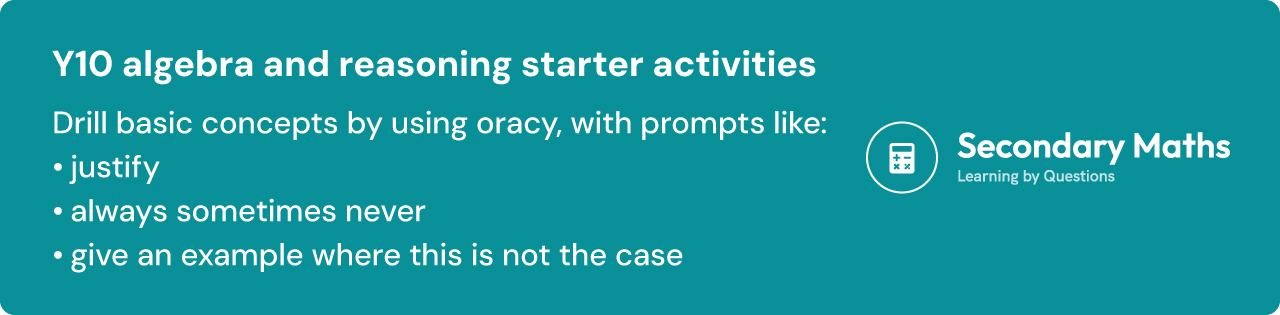
I would use oracy as a part of these starters to increase confidence and depth of understanding, using prompts like:
justify
always sometimes never
give an example where this is not the case.
Exposing students to these concepts repeatedly and consistently should take any uncertainty away, resulting in algebraically dextrous students - is that a thing? It should be.
Why are starter and end-of-lesson activities important for year 10?
The intent of this over-exposure and discussion around basic concepts through starter and end-of-lesson activities is two fold.
Firstly, to ensure that students are comfortably familiar with algebra (especially foundation students) so that they don’t shy away from answering these questions.
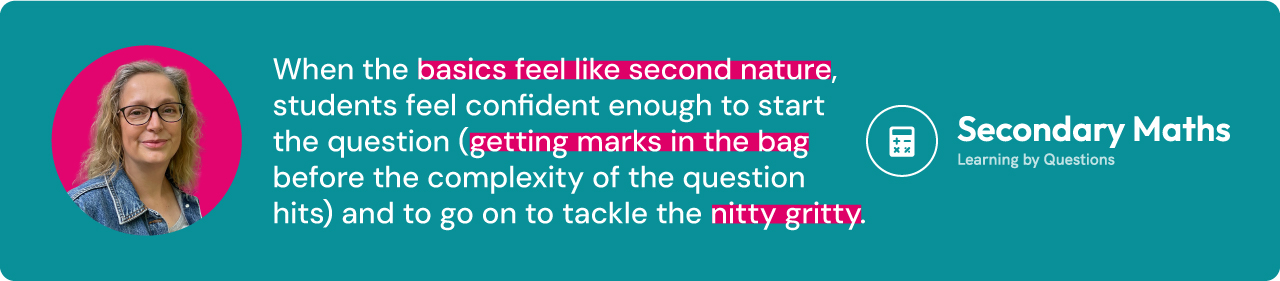
Secondly, it means students’ mental load isn’t stretched with the basics like rearranging an equation when they’re tackling more complex algebra questions. When the basics feel like second nature, students feel confident enough to start the question (getting marks in the bag before the complexity of the question hits) and to go on to tackle the nitty gritty.
So, by using the beginning and end of my lessons in this way, my year 10s are going to be consistently exposed to lots of lovely algebra (hopefully they will grow to love it too or at least not be scared of it!) and some puzzling problems based on multiplicative reasoning. This regular practice and discussion should result in better understanding and confidence.
When they're in the thick of GCSE revision later on in the year, check out our blog on maximising every GCSE mark.